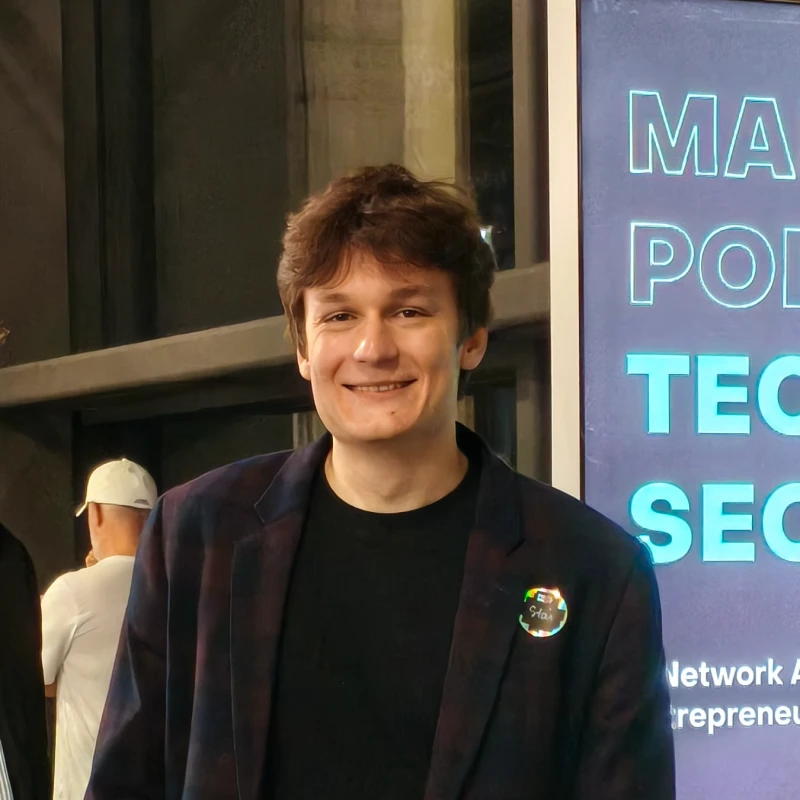
Stanisław Wasilewski
AI research at Bynder. MSc AI at the University of Amsterdam. Before that, two years at TasteRay, where I led the work on custom recommendation models and built production RAG. I have won a handful of hackathons, including the Neo4j Prize at Hack the Law in Cambridge, ran the tech behind a generative-AI hackathon of ~5,000 participants, and have been writing code since I was ten. I never stop building: dozens of side projects, from a ranked quiz game for my courses to AI agents that trade against each other.
Experience
CV (PDF) →-
Bynder
AI Research Intern, Bynder LabsResearch on retrieval, continual learning and multimodal LLMs. I turn recent research into working prototypes, run the experiments and find out which approaches hold up, including how well AI agents use our tools.
-
TasteRay
AI EngineerLed the work on custom recommendation models and built them. Researched the architectures, then built deep-learning recommenders to take over from LLM calls. Also production RAG across millions of items on Cloudflare Workers, D1, KV and Vectorize, agentic workflows, and Langfuse evaluation on every prompt change.
-
PixelRiot
Technical organiserBuilt and ran the tech behind a generative-AI hackathon of ~5,000 participants. Registration, the submission pipeline, automated email and the public site, plus $600k+ in API credits coordinated with ElevenLabs, Runway, Bolt and Fal AI. Same role before that at AI Creative Challenge.
-
Futurist Law Lab
Founding Member, AI Team LeadLed the AI team and ran workshops at the European Parliament and Pinsent Masons. Grew the AI team through sourcing and interviews, and designed workshops on AI in legal practice, the EU AI Act and the legal side of vibe coding. Futurist Law Lab merged into AISO in October 2026.
-
Aristosites
Co-Founder, Web DeveloperCo-ran a web agency for two years. Sites and small web apps for small and medium businesses with two partners, client relationships end to end, plus reusable themes and plugins.
-
Vrije Universiteit Amsterdam
Teaching AssistantTA for Machine Learning and Introduction to Python Programming. Weekly tutorials, grading and one-to-one help for students on the BSc AI programme.
Education
-
University of Amsterdam
MSc Artificial IntelligenceTwo research projects heading for publication. Including work on the limits of knowledge distillation. Every lecture’s notes are public at notes.swasilewski.com.
-
Vrije Universiteit Amsterdam
BSc Artificial IntelligenceHonours Programme, GPA 8.4/10. Minor in Situated AI. Thesis on cross-attention between functional and structural MRI.
Selected projects
-
CasePulse
A tool that checks a lawsuit before it goes to trial. You give it the claims and the evidence, and it shows which claims the evidence supports, which it contradicts and where the gaps are, with every finding linked to the exact line it came from. I built the analysis engine, which models the case as a graph. It won the Neo4j Prize for Best Use of a Graph Database at Hack the Law in Cambridge. When it is not confident, it says so instead of guessing.
Neo4j · NVIDIA Nemotron · Document AI · Cloudflare Workers -
ekocieplownia.pl
A public website and two AI agents for a planned waste-to-energy plant in Zduńska Wola, Poland. The public assistant answers residents’ questions from a knowledge base built on the plant’s documents and its environmental decision, and always cites its sources. The internal agent has full document access and advises the PR team on how to answer comments online. I built all of it over the summer, including the CMS, a dashboard for reviewing the assistant’s conversations and the video pages. Both agents are live.
Next.js · Sanity · Cloudflare Workers · RAG -
EU AI Act compliance checker
Point it at a GitHub repository and it tells you where that code stands against the EU AI Act, turning a long and dense regulation into concrete findings about one specific codebase. We built it as a team at the Legal Frontier Hackathon in May 2025, where it won first place, and kept developing it afterwards as ReguGator.
Next.js · Supabase -
Cross-attention for autism diagnosis
My bachelor’s thesis. I tested whether combining two kinds of brain scans, functional and structural MRI, helps a model recognise autism. I built eleven Transformer variants in which the two scan types attend to each other, and trained them on 871 people from the ABIDE dataset. The best reached 69.9% accuracy, against 63.5% with one scan type. None got past about 70% on scanning sites it had not seen, and the thesis explains why.
PyTorch · Transformers · neuroimaging -
uvarena
A ranked quiz game for two of my MSc courses. Students play one-on-one duels against each other by sharing a join code, and gain or lose rating with every match. The questions are written alongside my public lecture notes. I built and run all of it.
Cloudflare Workers · D1 · Durable Objects -
HyperGnome
An extension that brings automatic window tiling, in the style of the Hyprland window manager, to the GNOME desktop on Linux. New windows split the screen between them, with gaps, focus borders and a proper settings window. One codebase supports GNOME 46 to 49 on both Wayland and X11.
GJS · GNOME Shell · Clutter · GSettings
Everything else
| Year | Project | Type | Status |
|---|---|---|---|
| 2026 | Trading agents Claude agents paper-trading against each other, with a public dashboard | AI | live |
| 2026 | Knowledge distillation research on its limits, heading for publication | Research | in progress |
| 2026 | Pruning a translation LLM structured pruning of ALMA-7B at 20 to 40% sparsity, with LoRA repair; MSc NLP project | Research | report |
| 2026 | Lawsuit Tinder satirical case-matching app for the Pinsent Masons vibe-coding workshop | Tool | live |
| 2026 | life-ops personal memory repo for AI agents, with a dashboard and an MCP server on Cloudflare | Tool | in use |
| 2026 | Generative recommenders, reproduced reproduction and beyond-accuracy study of COSETTE and MARIUS; MSc recommender systems course | Research | report |
| 2026 | Polymath turns company goals into research questions and matches research teams to them; hackathon build | AI | archived |
| 2026 | Bike Radar searches Marktplaats for your stolen bike and has Gemini rank the matches | AI | prototype |
| 2026 | Safer pretraining, replicated replication and extension of an IJCAI 2025 paper on filtering harmful pretraining data; MSc course | Research | report |
| 2026 | Kill-Drill startup idea, since killed: removing dental drill noise from speech with a fine-tuned DeepFilterNet3 | AI | archived |
| 2026 | Na ile do pierdla? satirical calculator of which crimes add up to a chosen prison sentence (Polish) | Tool | archived |
| 2026 | wyjazdo.pl sign-ups and payments for small trip organisers | Tool | pilot |
| 2025– | Open MSc AI notes every lecture, public and searchable | Writing | live |
| 2025– | GenSnitch is this image AI-generated, from a right-click | Tool | live |
| 2025– | realpls.com image authenticity checks that run in the browser | Tool | live |
| 2025 | ReguGator the Legal Frontier winner, carried on as a startup attempt: a regulatory compliance assistant (RAG, LangGraph) | AI | archived |
| 2025 | Oratoria practise a difficult conversation against a voice agent, ElevenLabs hackathon | AI | archived |
| 2025 | DesignAI AI-assisted posters and social posts, a prototype | AI | archived |
| 2024 | Chatbots for local government research platform and report with Pracownia Zmiany, Warsaw | Research | report |
| 2023 | badGPT chatbots built to behave badly, with accounts and paying users | AI | offline |
| 2023 | Doxastic logic paper belief that tolerates contradictions without explosion | Research | paper |
| 2022 | Czy robot może być osobą? essay on AI personhood, Polityka | Writing | published |
| 2021 | KOLEKTOR youth cultural magazine, founder and editor in chief | Writing | archived |
Timeline
- 2013 First Unity games in C#, age 10 code
- 2016–19 C++ algorithmics, two mobile apps code
- 2019 TensorFlow, a first CNN code
- liceum Olympiad in Informatics, finalist code
- liceum Olympiad in Philosophy, finalist writing and philosophy
- 2021 Founded KOLEKTOR writing and philosophy
- 2022 Polityka essay on AI personhood writing and philosophy
- 2022 BSc AI, VU Amsterdam code
- 2023 badGPT, paying users code
- 2024 TasteRay code
- 2025 Futurist Law Lab workshops writing and philosophy
- 2025 1st, Legal Frontier code
- 2025 Open MSc notes writing and philosophy
- 2025 PixelRiot, ~5,000 code
- 2026 Neo4j Prize, Cambridge code
- 2026 AI research, Bynder code
- 2026 Pinsent Masons workshop writing and philosophy
About, in full
Stanisław Wasilewski (Stas) is an AI researcher and engineer based in Amsterdam. He does AI research at Bynder, the digital asset management company, working on retrieval, continual learning and multimodal LLMs, and on evaluating how well AI agents use tools. He is in the final year of an MSc in Artificial Intelligence at the University of Amsterdam, where he is part of two research projects heading for publication, one of them on the limits of knowledge distillation.
He started programming at ten, building games in Unity and C#, moved on to competitive algorithms in C++, and published two mobile apps before secondary school ended. He was training neural networks in TensorFlow at sixteen. In parallel he studied philosophy seriously: he reached the finals of both the Polish Olympiad in Informatics and the Polish Olympiad in Philosophy, received the Polish Prime Minister’s scholarship, founded the youth magazine KOLEKTOR, and at nineteen published an essay on AI personhood in Polityka, one of Poland’s leading weeklies. That pairing of engineering and philosophy runs through his work.
Before Bynder he spent two years as an AI engineer at the startup TasteRay. He led the work on custom deep-learning recommendation models that took over from LLM calls, and built production retrieval (RAG) across millions of items on Cloudflare’s edge stack, with agentic workflows and evaluation on every prompt change. Earlier he co-ran a web agency for two years and was a teaching assistant for Machine Learning and Introduction to Python Programming at VU Amsterdam, where he finished his BSc in AI in the Honours Programme with a GPA of 8.4/10.
He has won a handful of hackathons. At Hack the Law 2026 at the University of Cambridge, his team’s CasePulse, a tool that checks whether a lawsuit’s evidence supports its claims, won the Neo4j Prize for Best Use of a Graph Database; he built its analysis engine. His team also took first place at the Legal Frontier Hackathon in 2025 with an EU AI Act compliance checker. He was the technical organiser of PixelRiot, a generative-AI hackathon with about 5,000 participants, and has given workshops on AI and law at the European Parliament in Strasbourg, during the European Youth Event, and at Pinsent Masons.
He builds constantly. Recent side projects include uvarena, a ranked quiz game for his MSc courses; a set of AI agents that paper-trade against each other; HyperGnome, an open-source tiling extension for the GNOME desktop; and, for a planned waste-to-energy plant in Poland, a public website with two AI agents in production: one that answers residents’ questions with sources, and an internal one that advises the PR team. His lecture notes for every MSc course are public at notes.swasilewski.com.
Questions people ask
- What does he work on?
- Applied AI research and engineering: retrieval and RAG, recommender systems, continual learning, multimodal LLMs, and evaluating AI agents and their tool use.
- What has he shipped to production?
- Custom recommendation models and a large-scale RAG system at TasteRay, a public RAG assistant and an internal advisory agent for a waste-to-energy plant’s information site, and the registration and submission infrastructure for a ~5,000-person hackathon.
- What are his strongest skills?
- Deep learning in PyTorch, including custom Transformer architectures; retrieval and recommendation systems; knowledge graphs; and building and deploying full systems on Cloudflare (Workers, D1, KV, Vectorize). He puts a lot of weight on evaluation: knowing whether a system actually works.
- Has he won anything?
- The Neo4j Prize at Hack the Law 2026 (University of Cambridge), first place at the Legal Frontier Hackathon 2025, and finalist places in the Polish Olympiads in Informatics and in Philosophy.
- Does he write and teach as well?
- Yes: the Polityka essay, the KOLEKTOR magazine, public lecture notes, TA work at VU, and workshops for lawyers and policymakers.
- Which languages does he speak?
- Polish (native) and English (fluent).
- How can I reach him?
- By email at [email protected], or via LinkedIn (linkedin.com/in/stanislaw-wasilewski) and GitHub (github.com/Stasieniec).